Fraud detection
Spot suspicious orders, payments, claims and account activity early, with clear rules, machine-learning risk scores and a review queue where your team makes the final call.
Share a few details and our team will call you back within one working day.
Fraud detection software watches transactions and account activity for signs that something is not right, and acts before the loss happens. In e-commerce that might be a cash-on-delivery order from an address with a history of refusals. In an expense or insurance system it could be a claim that repeats an earlier bill. In a fintech app it could be a login from a new device followed immediately by a change of bank details.
Manual checks catch some of these cases, but they are slow, inconsistent and hard to scale as volumes grow. A dedicated system checks every transaction the same way, in real time, and sends only the suspicious ones to your team with the reasons clearly shown. Genuine customers pass through without delay, while reviewers spend their time on the cases that need attention.
Over time, the record of flagged and confirmed cases also becomes valuable intelligence, showing where your process is weakest and which controls are worth strengthening.
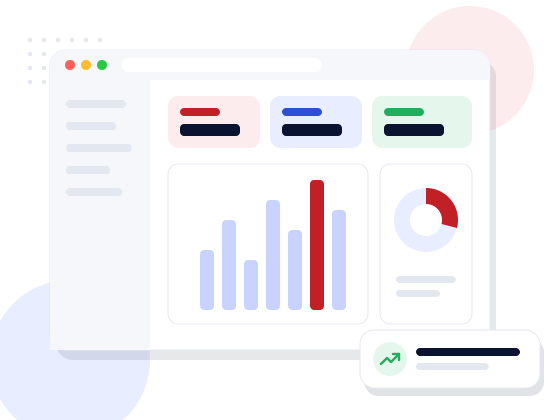
Rules are the foundation. They are easy to understand, work from day one and reflect what your team already knows about fraud in your business: limits on order value, how many attempts are allowed in an hour, blocked phone numbers or pin codes, and mismatches between billing and delivery details. Your team can adjust rules from an admin panel as new patterns appear.
Machine learning adds a second layer. Once enough confirmed fraud and genuine cases are recorded, a model learns subtler combinations of signals that rules alone miss and gives each transaction a risk score. Rules and scores work together, so the system can block clear-cut cases, approve low-risk ones and route the uncertain middle to people.
The right balance between rules and scores depends on your volumes and how quickly fraud patterns change in your sector, and we revisit it as the system matures.
The review queue is where most of the value is realised, so we design it carefully. Each flagged case shows the transaction, the customer's history and the specific reasons it was flagged. Reviewers can approve, reject or ask for more information, such as a call to confirm a COD order or an additional document for a claim, and each decision is recorded.
Those decisions feed back into the system. Confirmed fraud strengthens the rules and the model, while false alarms show where thresholds are too strict. Regular reports show flag rates, confirmed losses prevented by category and the time cases spend waiting, which helps you balance protection against the experience of genuine customers.
We have built e-commerce platforms, payment integrations, financial portals and business software for more than ten years, for clients in India and abroad. That gives us a practical understanding of where fraud enters real systems, from payment gateway webhooks to order management and claims workflows, and how checks can be added without breaking the customer journey.
We start with your historical data and your team's experience, build rules first and add machine learning as labelled cases accumulate. Sensitive data is handled with strict access controls and encryption, the work can be covered by an NDA, and you own the code and models.
We usually begin with a review of past transactions and known fraud cases, which shows where losses are concentrated and which signals are available. A first set of rules can then go live quickly, often in a monitoring mode that flags without blocking, so thresholds can be tuned on live traffic before they affect customers.
What we deliver
Chatbots, AI agents, forecasting and fraud detection that put your data to work.
Business rules for limits, velocity, locations and blacklists.
Machine-learning scores from historical patterns of fraud.
Transactions scored as they happen, before money or goods move.
Device, IP, location and usage patterns added to each risk check.
Flagged cases with the reasons, for quick approve or reject.
Instant notifications for high-risk events.
Flag rates, outcomes and false alarms tracked so thresholds can be adjusted.
Every decision logged for compliance and later analysis.
Who it’s for
Every project starts from your process, not a template. These are typical situations we are asked to solve.
Discuss your requirementHow we work
Find the tasks and decisions where AI saves real time or money.
Review the data you have, its quality and what is safe to use.
A working proof of concept on your own data, measured against today.
Connect it to your website, WhatsApp, CRM or ERP, with human review where needed.
Track accuracy and cost, and keep improving the model and prompts.
Technology
We pick the stack for your project, your team and your budget — not the other way round.
FAQ
Straight answers to what clients usually ask first.
We tune rules and thresholds on your historical data and send borderline cases to review instead of blocking them.
Rules work from day one. Machine-learning scoring improves as labelled cases build up.
Yes. Checks can run before or after the gateway, using its webhooks and your order data.
Yes. Every flag lists the rules triggered and the main factors behind the risk score, so reviewers and auditors can see the reasoning.
Access is role-based, data is encrypted in transit and at rest, and only the fields needed for checks are used.
It depends on transaction volume, the number of data sources, real-time requirements and whether machine learning is included from the start. We estimate after reviewing your data.
Speak directly with our technical architects. We provide actionable tech recommendations, architecture planning, and transparent timelines — with zero obligation.