ERP development
One system for stock, purchase, sales, production, accounts and people, designed around your workflow and rolled out one module at a time so daily work never has to stop.
Share a few details and our team will call you back within one working day.
Custom ERP software development means building an enterprise resource planning system around the way your company buys, makes, stores and sells. Most growing businesses reach a point where stock is tracked in one tool, invoices in another and production on paper or in a spreadsheet. Each department works from its own numbers, and somebody spends hours each month reconciling them. An ERP replaces those disconnected records with one database that every department reads from and writes to.
Ready-made ERPs suit companies whose processes match the product. Manufacturers with job work, traders with several price lists, or groups running multiple units under different GST registrations often find that standard packages need heavy workarounds. A custom ERP keeps your existing terms, document formats and approval chains, so staff learn a tool that looks like their job rather than adapting their job to the tool.
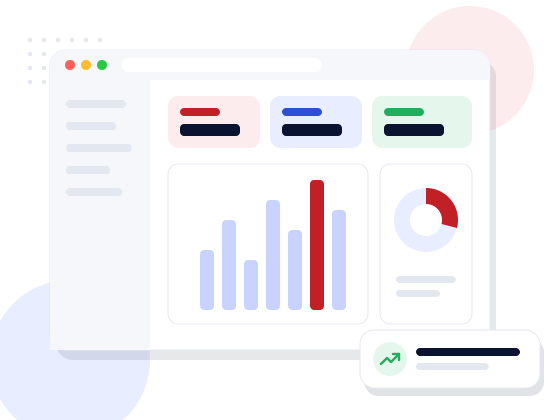
We plan the system as modules that share one set of masters: items, customers, suppliers, employees, locations and ledgers. A sale reduces stock, raises an invoice and updates the customer's outstanding balance in a single step. A purchase order flows to goods receipt, quality check, stock and the supplier's payable, with no re-typing between departments. Reports then draw on live transactions, so management sees today's stock, sales and dues rather than last month's summary.
Not every company needs every module. A distributor may need stock, sales and accounts but no production. A factory may start with production planning because that is where most time is lost. We recommend the order of modules after studying where errors and delays cost you the most. Each later module plugs into the same masters, so adding one does not mean redoing those already in use, and each phase can be budgeted on its own.

An ERP rarely replaces everything on day one. Many clients keep their existing accounting package, such as Tally, and we exchange masters and vouchers with it instead of moving years of financial history. Other common links include e-commerce stores, payment gateways, barcode scanners and label printers, biometric attendance devices, SMS and WhatsApp alerts, and a CRM on the sales side.
Migration is planned module by module. We clean item codes, merge duplicate customers and verify opening stock and balances with your team before switching over. The old system stays available as a reference until the new module's numbers are signed off, which keeps the risk of a bad go-live low. Staff are trained on real entries from their own department during this period, which builds confidence before the old method is retired.
Web Ultra Solution is an ISO 9001:2015 certified company headquartered in Noida, with offices in Mumbai, Madhubani and Vilnius. Over ten years and more than 2,500 projects, we have built business software for clients in India and in countries such as Kenya, Zimbabwe and Lithuania. Our ERP work follows a phased plan, with each module demoed and approved before the next begins.
You own the source code, we sign an NDA on request, and the system can run on your server or on cloud hosting we manage. After launch we stay on for support, training of new staff and additional modules, so the ERP grows with your branches, product lines and team. The same team stays your point of contact from requirement study to support, so you do not have to explain your business again at each stage.
What we deliver
ERP, CRM, HRMS and vendor management built for your processes, not the other way round.
Items, parties, employees and ledgers are entered once and used by every module.
Run several branches, warehouses or plants with reports per location and combined.
Purchase, discount and expense approvals follow your hierarchy, with a record of who approved what.
Owners, store managers and accountants each see the figures they act on.
Tax invoices, credit notes and HSN-wise summaries generated from the same transactions.
Changes to key records are logged with user and time, which helps during audits.
Approvals, stock checks and sales orders from a phone browser or a companion app.
Department and management reports in your format, exportable to Excel and PDF.
Who it’s for
Every project starts from your process, not a template. These are typical situations we are asked to solve.
Discuss your requirementHow we work
Department-by-department process mapping and reporting needs.
Module plan, roles and permissions, approvals and integrations.
Core modules first, then the rest, each demoed and signed off.
Data migration from spreadsheets or old software, then user training.
Hosting, backups, updates and new modules as you grow.
Technology
We pick the stack for your project, your team and your budget — not the other way round.
FAQ
Straight answers to what clients usually ask first.
The main factors are the number of modules, the complexity of your production or pricing rules, the integrations required, the volume of data to migrate and the number of locations and user roles. We give a module-wise estimate in the proposal after a requirement study.
It depends on scope and how ready your data is. Because we build in phases, the first module can go live well before the full system is complete. The proposal includes a phase-wise timeline that we agree with you.
This page covers ERP built for product businesses such as manufacturers, traders and distributors. Our enterprise resource planning page describes a ready system for coaching and training institutes that we configure rather than build from scratch.
Often yes. We can integrate with your accounting package so that sales, purchase and payroll entries flow across, and decide together whether a full accounts module makes sense later.
We do, department by department as each module goes live, with short role-based sessions and written guides. New staff can be trained later as part of support.
Access is restricted by user role, sensitive actions are logged and backups are scheduled. You choose whether the ERP runs on your own server or on managed cloud hosting, and the data stays yours.
Watch in 30 seconds
Speak directly with our technical architects. We provide actionable tech recommendations, architecture planning, and transparent timelines — with zero obligation.