Forecasting & analytics
Use your own sales history, seasons and trends to forecast demand, so you stock, produce and staff for what is coming rather than what happened last month.
Share a few details and our team will call you back within one working day.
Demand forecasting turns your sales history into an estimate of what customers will buy in the coming weeks and months. Without it, most purchase and production decisions rely on last month's figures and the experience of a few people. That works until a festival arrives early, a product suddenly takes off or a slow-moving item fills the warehouse.
Too much stock ties up cash, takes up space and risks expiry or obsolescence. Too little means lost sales, rushed purchases at higher prices and unhappy customers. A forecast does not remove uncertainty, but it gives planners a consistent, data-based starting point and a clear view of how confident that estimate is, so they can apply judgement where it matters most.
Forecasts also help beyond purchasing. Finance can plan working capital, HR can plan seasonal staffing, and sales can set targets that reflect real patterns rather than round numbers.
None of this requires complex software on your side. The forecast can run quietly in the background and appear as a few extra columns in the purchase screens your team already uses.
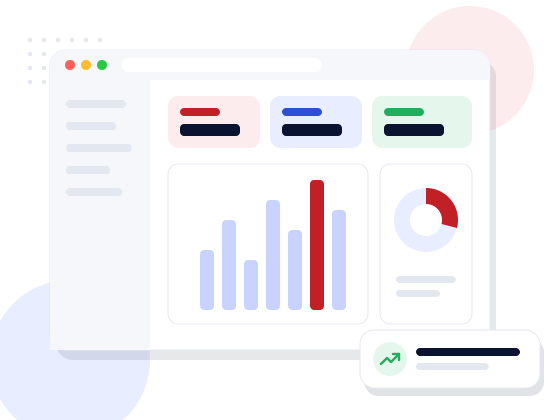
Every forecasting project starts with the data. We gather sales, stock, pricing and calendar information from your ERP, billing or inventory system, then clean it: removing duplicates, handling returns, filling gaps and marking periods affected by stock-outs, so the model learns real demand rather than what happened to be available.
We then test several approaches, from established statistical methods to machine-learning models, and compare their accuracy on past periods the model has not seen. The method that performs best on your data is chosen, and we explain in plain terms how reliable it is for different products and locations.
We also look at the level of detail that is realistic. Forecasting every item at every branch for every day is rarely reliable, especially for slow movers. Often the best results come from forecasting at a category or weekly level and then splitting the figure down using recent patterns, which gives planners usable numbers without false precision.
A forecast is only useful if it reaches the people making decisions. We deliver it where they already work: inside your inventory or ERP software, on a dashboard, or as a scheduled report. Forecasts can be converted into reorder suggestions that take current stock, lead times, minimum order quantities and safety stock into account.
Planners stay in control. They can adjust a forecast for information the model cannot know, such as a confirmed bulk order or a planned price change, and the system records the override. What-if views let managers see how a promotion or a delayed shipment might affect stock. Forecast-versus-actual reports show how accurate each forecast was, so trust is built on evidence.
We build the inventory, ERP and billing systems that forecasts depend on, so we understand how sales and stock data are recorded in Indian businesses, including GST invoices, branch transfers and returns. Over more than ten years of projects for clients in India and abroad, we have found that clean data and a practical delivery method matter as much as the choice of model.
We begin with a free review of your data to check whether it is sufficient, then run a proof of concept on a few categories before rolling out more widely. You own the models and code, the work can be covered by an NDA, and we monitor accuracy and retrain models as your business changes.
What we deliver
Chatbots, AI agents, forecasting and fraud detection that put your data to work.
Clean and combine sales, stock and calendar data from your systems.
Statistical and machine-learning models chosen for your data.
Festivals, promotions and local events factored in.
Forecasts by product, category, store or region.
Recommended purchase quantities based on the forecast and current stock.
See how promotions, price changes or supply delays may affect demand and stock.
Forecast versus actual reports so you know how far to trust it.
Who it’s for
Every project starts from your process, not a template. These are typical situations we are asked to solve.
Discuss your requirementHow we work
Find the tasks and decisions where AI saves real time or money.
Review the data you have, its quality and what is safe to use.
A working proof of concept on your own data, measured against today.
Connect it to your website, WhatsApp, CRM or ERP, with human review where needed.
Track accuracy and cost, and keep improving the model and prompts.
Technology
We pick the stack for your project, your team and your budget — not the other way round.
FAQ
Straight answers to what clients usually ask first.
Usually at least a year of sales history works best, so seasonality can be learned. We check your data before committing.
Yes. Forecasts and reorder suggestions can appear inside your existing system or on a dashboard.
That depends on your data and market. We measure accuracy on past data before launch and track it continuously.
New items can be forecast from similar products, categories or launch patterns, and the forecast improves as real sales come in.
Typically weekly or daily, depending on how quickly your business moves and how often source data is refreshed.
It depends on the number of products and locations, the condition of the data and where forecasts need to appear. The data review lets us give a scoped estimate.
Speak directly with our technical architects. We provide actionable tech recommendations, architecture planning, and transparent timelines — with zero obligation.